How to use
- Choose phone or computer. This sets the viewing distance the letter sizes are calculated for: 40 cm (16 in) for a phone, 60 cm (24 in) for a computer.
- For accurate sizes, calibrate once with any bank, credit or ID card: hold it upright against the screen and match the box to its short side.
- Wear your usual glasses or contacts, sit at the chosen distance in good light, and cover one eye.
- An E appears in smaller and smaller sizes. Tap the arrow that matches the way its legs point; get 2 of 3 right to move to the next line. Then test the other eye.
What the eye chart numbers mean
Vision is written as a fraction. 20/20 means you can read at 20 feet what a person with normal vision reads at 20 feet. 20/40 means you need to be at 20 feet to read what a person with normal vision can read from 40 feet away.
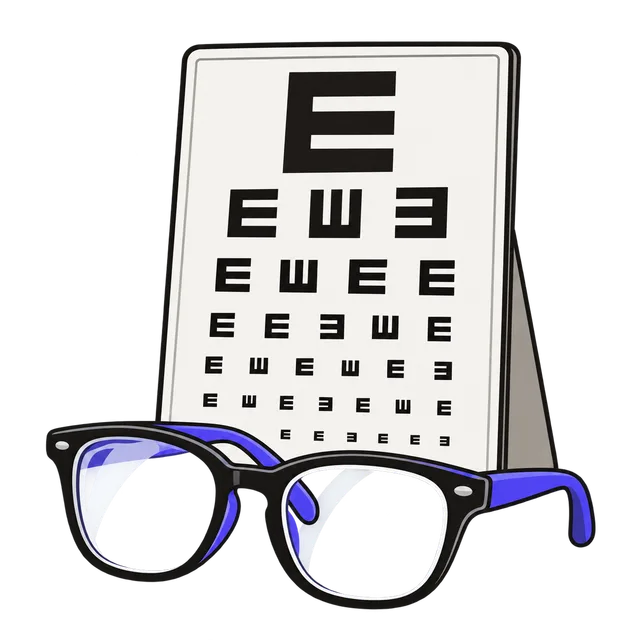
The test uses the tumbling E, the eye chart used for people who cannot read letters. Each line is drawn so that the 20/20 letter is 5 arc-minutes tall at your viewing distance, the same standard printed eye charts follow.
| Result | What it means |
|---|---|
| 20/20 or 20/25 | Normal sharpness of vision |
| 20/30 to 20/40 | Slightly reduced; 20/40 or better is needed for an unrestricted driver's license in most states |
| 20/50 to 20/100 | Reduced; see an eye doctor |
| 20/200 or worse | Legally blind if this is the best vision with glasses or contacts |
How accurate is an online vision test?
A screen test is a rough check, not an eye exam. Letter size depends on your screen and how far away you sit, so the calibration step and a steady distance matter. Without calibration, the result can be off by about one line.
Some screens cannot draw the smallest letters sharply at a short distance. When that happens, the test stops at the smallest line your screen can show and tells you that your vision may be better.
A good result does not rule out eye disease. Glaucoma, cataracts, macular degeneration and diabetic eye disease can start without any change in sharpness, which is why regular eye exams matter even when you see well.
When to see an eye doctor
The American Academy of Ophthalmology recommends a baseline eye disease screening by age 40, when early signs of disease and changes in vision often begin. See an eye doctor sooner if your result is 20/40 or worse, if one eye tests clearly worse than the other, or if you notice blurred patches, flashes, many new floaters, or straight lines that look wavy.
Sudden vision loss, a curtain over part of your vision, or eye pain with redness needs urgent care the same day.
Frequently asked questions
Can I check my vision at home?
Yes, for a rough check. Calibrate the screen with a card, sit at the stated distance and test one eye at a time with your usual glasses. Use the result to decide whether to book an eye exam, not instead of one.
What does 20/40 vision mean?
You see at 20 feet what a person with normal vision sees at 40 feet. It is the minimum most US states require for an unrestricted driver's license.
How many adults have 20/20 vision?
According to the American Academy of Ophthalmology, about 35% of adults have 20/20 vision without glasses, contacts or surgery, and about 75% reach it with correction.
Is my result saved or sent anywhere?
No. The test runs in your browser. Only the screen calibration is remembered on this device, so you don't have to repeat it.
What vision test does the DMV use?
Most US DMVs screen distance vision with a letter chart or a vision-testing machine. Many states ask for about 20/40 in at least one eye, with glasses or contacts allowed, for a standard license, and some also check side vision. Rules differ by state, so check your state's DMV site before you go.
Can an eye test detect diabetes or high blood pressure?
A chart like this one only measures how sharp your vision is. A dilated eye exam by an optometrist or ophthalmologist can show changes in the blood vessels at the back of the eye caused by diabetes or high blood pressure, often before you notice any change in your sight. That is why people with diabetes are advised to have regular dilated eye exams, usually once a year.